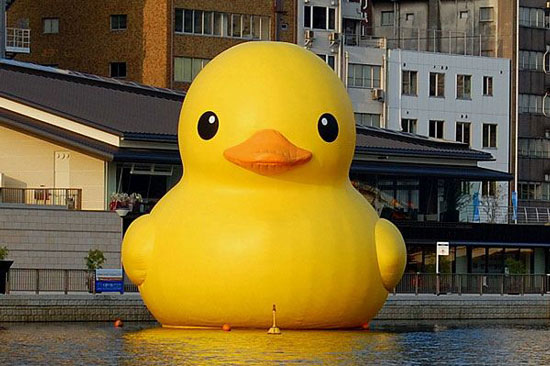
A 10m tall giant rubber duck, created by Dutch artist Florentijn Hofman, was displayed in the Japanese city of Osaka recently. The rubber duckie (and its taller cousin) has been travelling around the world since its creation in 2007.

A 10m tall giant rubber duck, created by Dutch artist Florentijn Hofman, was displayed in the Japanese city of Osaka recently. The rubber duckie (and its taller cousin) has been travelling around the world since its creation in 2007.

The Gate Tower Building, commonly known as Bee Hive, is an office building in Osaka, Japan, famous for having a highway passing through the 5th-7th floor of the building.
According to the Japanese wiki… the story could date back to 1983 when the old structure at the location had to be reconstructed due to its old age, but the city planner had decided to acquire the land to build a highway instead.
Not sure who initiated the idea, but after five years of negotiation, the land owner and involved parties reached an agreement that the highway would be constructed through the new 16-storey office building as it is now.
The construction started in 1989 and was completed in 1992.
A group of researchers at Osaka Bioscience Institute (OBI) has identified a protein that is necessary to efficiently transmit visual information and named it the protein Pikachurin after Pikachu, a popular anime character in Pokémon. [via Yomiuri]

As bizarre as it sounds, this is not the first time that a scientific term is named after an anime character…
There is a protein called Sonic Hedgehog Homolog (SHH) which plays a key role in the growth of digits on limbs and organisation of the brain.
There is another gene named as Pokemon (which happens to be an acronym for POK erythroid myeloid ontogenic factor), a gene that may act as a master switch for cancer. The name was later changed to Zbtb7 after some strong protest from the Pokémon company because they don’t want to share their name with a cancer-causing gene.
About 50 monkeys at Ohama park in Osaka, Japan, have been so overfed by tourists that they are now massively overweight, and officials have been forced to put them on a strict diet. [Xinhuanet]

Conveyor belt sushi (回転寿司, kaitenzushi) celebrates its 50th anniversary on April 2008. Yoshiaki Shiraishi (1914-2001) opened the first conveyor belt sushi Mawaru Genroku Sushi in Osaka in 1958.
The concept has revolutionised the Japanese food culture, with thousands of conveyor belt sushi restaurants operating around the world.
Some might argue that the kaitenzushi is not of the highest quality, which is probably true… but it allows the consumers to have sushi at much cheaper price, and that’s probably why these restaurants are so popular. Most of the people who visit these places are aware of the flaw anyway.
Btw, the kaitenzushi also has a cute name in Japan… the kuru kuru sushi (くるくる寿司, literally sushi-go-around). The Australians are more direct with the name though, by simply calling it the train sushi.
[Reference from Wikipedia; Hat tip to Japan Navigator]
The Cui-daore (くいだおれ), an iconic restaurant in Osaka’s Dotonbori eating district, is closing down in July after 60 years in business.
Operating since 1949, the restaurant will be closing down on July 8 because of its aging building and facilities and limitations of its family-run business. [Asahi]
The restaurant’s famous mascot, the Cui-daore Taro, is however likely to continue its legacy though. The restaurant is flooded with hundreds of offers to buy and rent its mascot after the closure announcement was made last week.
Also known as Kuidaore Ningyo, the drum beating mechanical doll dressed in a striped clown suit is considered by many as the most popular landmark in Osaka.